Principles of Deep Representation Learning via Low-Dimensional Models



Monday, December 7, 2026, 2:00–5:00 PM AEDT
Parkside 1, ICC Sydney
Overview
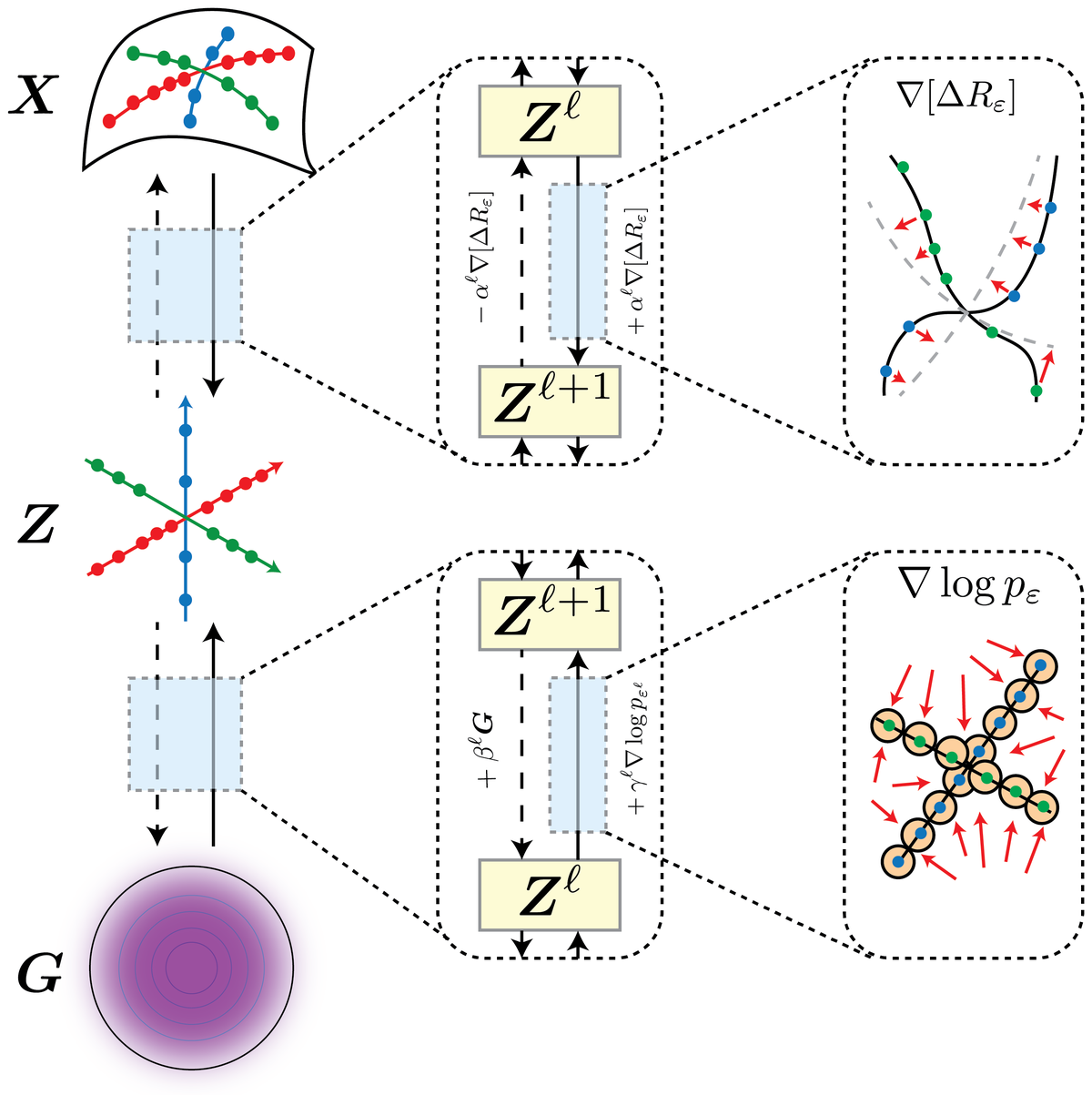
In the current era of deep learning, and especially of generative AI, there is significant investment in training very large models. Thus far, such models have been “black boxes” with opaque internal mechanisms, leading to difficulties in interpretability, reliability, and control. This tutorial is an attempt to open the black box through the perspective of representation learning: why and how deep networks learn compact and information-dense representations of high-dimensional real-world data.
The tutorial includes three parts. We begin with the low-dimensional structures of real-world data and how such distributions are learned through denoising and lossy compression. We then explain how deep networks generalize and learn data distributions without the curse of dimensionality. Finally, we show how diffusion models learn representations and how to further evaluate and control them.
Schedule
PM, Sydney time (AEDT, UTC+11).
| Time | Session | Speaker | Slides |
|---|---|---|---|
| 2:00 – 2:05 | Opening remarks | Yi Ma | |
| 2:05 – 3:00 | Part I Title to be announced | Yi Ma | Soon |
| 3:00 – 3:10 | Break | ||
| 3:10 – 3:55 | Part II Title to be announced | Peng Wang | Soon |
| 3:55 – 4:40 | Part III Title to be announced | Qing Qu | Soon |
| 4:40 – 5:00 | Questions and answers |
Materials
- Slides
- Slides for each part will be linked in the schedule above.
- Recording
- A link to the recording will be added here once it is available.
- Reading
- S. Buchanan, D. Pai, P. Wang, and Y. Ma, Principles and Practice of Deep Representation Learning: book website, arXiv.
- Earlier tutorials
- ICCV 2025, CVPR 2024.